Properties of Conductors
Chapter 3 — Conductors
A conductor is a material containing a large population of free charges (electrons in a metal, ions in salty water). In electrostatic equilibrium these free charges have rearranged themselves so that nothing is accelerating. That single requirement — no free charge feels a net force — locks in a whole family of powerful consequences.
The five properties
In electrostatic equilibrium:
- The field vanishes inside: \(\vec{E} = 0\) everywhere in the bulk. If it weren't, free charges would feel a force and keep moving — not equilibrium.
- Conductors are equipotentials: \(V = \text{const}\) throughout. For any two points connected by a path inside the conductor, \(\Delta V = -\int \vec{E}\cdot d\vec{s} = 0\).
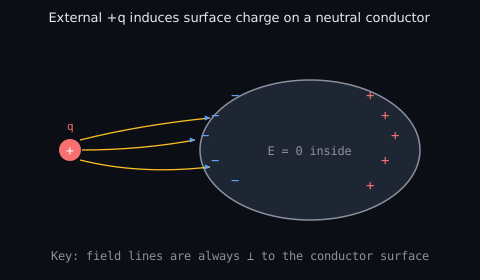
- External field is perpendicular to the surface: any tangential component would push surface charges along the surface.
- No bulk charge: \(\rho = \epsilon_0\,\vec\nabla\cdot\vec{E} = 0\) inside (since \(\vec{E}=0\)).
- All net charge lives on the surface: consequence of (4) combined with charge conservation.
Induced charge and screening
Drop a neutral conductor into an external field. The free charges drift until they cancel that field inside the conductor. The result is a non-uniform surface charge — negative on the side facing positive external charges, positive on the opposite side. From outside, the conductor looks like it has acquired a dipole (and higher multipoles).
Grounded vs. isolated
An isolated conductor has a fixed total charge \(Q\); its potential adjusts. A grounded conductor is connected to a huge reservoir (the Earth) held at \(V = 0\); charge flows on or off freely to maintain that potential. Most image-charge problems use grounded conductors.
Cavities inside conductors
If the conductor has a hollow cavity and no charge is placed in the cavity, the field in the cavity is exactly zero — regardless of what happens outside. If you put a charge \(q\) inside the cavity, an induced charge \(-q\) appears on the cavity wall and \(+q\) redistributes on the outer surface (see the Faraday cage page for more).
Practice Problems
Hint
Solution
All \(Q\) sits on the outer surface (no bulk charge). The field everywhere inside — including the center — is zero.
Answer: All charge on the surface; \(\vec{E}(0) = 0\).
Hint
Solution
Inside shell 1 (\(r < R_1\)): by symmetry and \(\vec{E}=0\) inside the conductor at \(r=R_1^-\), the enclosed charge must be zero, so the inner surface of shell 1 carries 0 and the outer surface carries \(Q_1\). Between shells (\(R_1 < r < R_2\)): \(\vec{E} = \frac{kQ_1}{r^2}\hat r\). Inside shell 2 the field is again zero, so a Gaussian sphere at \(r = R_2^-\) requires enclosed charge \(0\), forcing \(-Q_1\) on the inner surface of shell 2. Charge conservation on shell 2 puts \(Q_1 + Q_2\) on its outer surface. Outside (\(r > R_2\)): \(\vec{E} = \frac{k(Q_1+Q_2)}{r^2}\hat r\). Inside shell 1: \(\vec{E}=0\).
Answer: surfaces \((0,\ Q_1,\ -Q_1,\ Q_1+Q_2)\) from innermost to outermost.
Hint
Solution
The cavity wall develops induced charge \(-q\); the outside gets \(+q\). If the cavity is spherical and the charge is at its center, the induced \(-q\) is uniform and exerts zero net force on \(q\). Even off-center, the only field inside the cavity comes from charges in the cavity — so the force on \(q\) from "outside" is zero: complete screening. The outside charge \(q_0\) sees a distant conductor with net surface charge \(+q\) on the outside (since \(d \gg R\), it looks like a point charge \(+q\)), giving a Coulomb force \(\approx \frac{1}{4\pi\epsilon_0}\frac{q\,q_0}{d^2}\).
Answer: force on inside charge is 0 (spherical cavity, charge at center); outside charge feels \(\approx kqq_0/d^2\).
Hint
Solution
False. A neutral conductor in an external field has equal amounts of induced \(+\) and \(-\) surface charge on opposite sides. Locally \(\sigma \ne 0\); globally \(\oint \sigma\,dA = 0\).
Answer: False.