The Electric Field
Chapter 1 — Electrostatics
Coulomb's law sounds uncomfortably like action at a distance. The electric field reframes the story: a charge sets up a field \(\vec E(\vec r)\) everywhere in space, and any other charge simply responds to the local field. You'll see later in the course that this field is a physically real object — it carries energy, can exist without charges, and propagates at a finite speed.
Definition
The electric field at \(\vec r\) is the force per unit charge on a tiny positive test charge placed there:
\[\vec E(\vec r) = \frac{\vec F_{\text{on }q'}}{q'}.\]
The test charge cancels out of the expression entirely, so \(\vec E\) is a property of the source configuration alone. Units: N/C (equivalently V/m).
Field of a point charge
For a point charge \(q\) at the origin, Coulomb's law divided by the test charge gives
\[\vec E(\vec r) = \frac{1}{4\pi\epsilon_0}\frac{q}{r^2}\,\hat r.\]
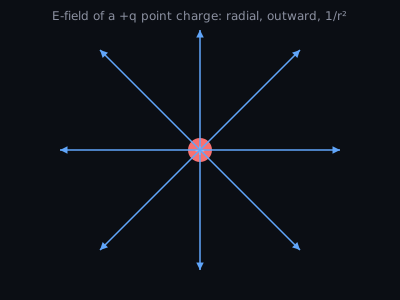
It points radially outward for \(q > 0\) and inward for \(q < 0\), and falls off as \(1/r^2\). If instead the charge sits at \(\vec r_0\), replace \(\vec r\) with \(\vec r - \vec r_0\).
Superposition of fields
Fields add as vectors, just like forces:
\[\vec E(\vec r) = \sum_i \frac{1}{4\pi\epsilon_0}\frac{q_i}{|\vec r - \vec r_i|^2}\,\frac{\vec r - \vec r_i}{|\vec r - \vec r_i|}.\]
Then the force on a charge \(Q\) placed at \(\vec r\) is \(\vec F = Q\vec E(\vec r)\) — Coulomb's law in disguise.
Visualization: vector plots vs field lines
Two common pictures: vector plots (arrows at a grid of points, length = magnitude) and field-line diagrams (continuous curves tangent to \(\vec E\) at every point). Field lines start on positive charges and end on negative charges (or at infinity). The density of field lines in a region is proportional to \(|\vec E|\) — this is the seed of the idea that leads to flux and Gauss's law.
Practice Problems
Hint
Solution
\(|\vec E| = (9\times 10^9)(2\times 10^{-6})/25 = 720\) N/C. Direction: \((0.6, 0.8, 0)\).
Answer: \(\vec E = (432, 576, 0)\) N/C.
Hint
Solution
Each charge produces a field at the origin of magnitude \(kq/a^2\), but pointing in opposite directions (each radially outward from the charge means toward the origin, then through it). By symmetry the two contributions cancel.
Answer: \(\vec E = 0\).
Hint
Solution
Each contributes magnitude \(kq/(a^2+y^2)\). The \(x\)-component of each is \(-kq/(a^2+y^2) \cdot (a/\sqrt{a^2+y^2})\) (pointing in \(-\hat x\) direction from the \(+\) charge, same from the \(-\) charge after flipping). Net \(E_x = -2kqa/(a^2+y^2)^{3/2}\).
Answer: \(\vec E = -\dfrac{2kqa}{(a^2+y^2)^{3/2}}\,\hat x\), pointing from \(+\) toward \(-\) side.
Hint
Solution
\(\vec F = -eE\hat y\), so \(\vec a = -(eE/m_e)\hat y = -(1.6\times 10^{-19})(100)/(9.1\times 10^{-31})\,\hat y \approx -1.76\times 10^{13}\,\hat y\) m/s\(^2\).
Answer: \(a\approx 1.76\times 10^{13}\) m/s\(^2\) in the \(-\hat y\) direction (opposite \(\vec E\)).