Field of a Dipole
Chapter 1 — Electrostatics
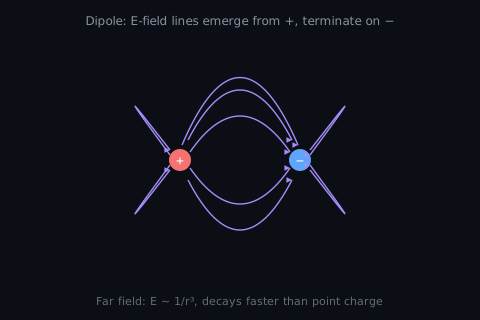
A pair of equal-and-opposite charges separated by a small distance is the simplest charge-neutral object you can build. It shows up constantly in physics — water molecules, antennas, polarized atoms — and its field has a characteristic \(1/r^3\) falloff that sets it apart from a point charge.
Dipole moment
Two charges \(+q\) at \(\vec d/2\) and \(-q\) at \(-\vec d/2\) have a net dipole moment
\[\vec p = q\vec d,\]
pointing from the negative charge to the positive charge. Units: C·m. For general charge distributions, \(\vec p = \sum_i q_i \vec r_i\) (independent of origin whenever total charge is zero).
Field along the axis
Put the dipole on the \(z\)-axis with \(+q\) at \(z = +d/2\) and \(-q\) at \(z = -d/2\). At a point \((0,0,r)\) with \(r \gg d\), expand each Coulomb term and keep the leading correction:
\[E_z = \frac{kq}{(r-d/2)^2} - \frac{kq}{(r+d/2)^2} \approx \frac{2kqd}{r^3} = \frac{1}{4\pi\epsilon_0}\frac{2p}{r^3}.\]
On the axis the field points along \(\vec p\).
Field in the perpendicular plane
At a point \((x,0,0)\) on the midplane, the contributions from \(+q\) and \(-q\) add vectorially and the horizontal components cancel. What's left points antiparallel to \(\vec p\), with magnitude
\[E_\perp = \frac{1}{4\pi\epsilon_0}\frac{p}{r^3}.\]
Key takeaways: (1) dipole field drops like \(1/r^3\) — faster than a point charge. (2) The axial field is twice the perpendicular field. (3) In the far-field, the general form is \(\vec E = \frac{1}{4\pi\epsilon_0}\frac{1}{r^3}\left[3(\vec p\cdot\hat r)\hat r - \vec p\right]\).
Dipole in an external field
A dipole in a uniform external field \(\vec E\) feels no net force, but does feel a torque
\[\vec\tau = \vec p \times \vec E,\]
which tries to align \(\vec p\) with \(\vec E\). The potential energy is \(U = -\vec p\cdot \vec E\).
Practice Problems
Hint
Solution
\(p = (10^{-9})(2\times 10^{-3}) = 2\times 10^{-12}\) C·m, pointing in \(+\hat z\).
Answer: \(\vec p = 2\times 10^{-12}\,\hat z\) C·m.
Hint
Solution
\(E = 2(9\times 10^9)(2\times 10^{-12})/(0.1)^3 = 3.6\times 10^{-2}/10^{-3} = 36\) N/C.
Answer: \(\approx 36\) N/C along \(\vec p\).
Hint
Solution
\(E_{\text{axial}}/E_\perp = (2kp/r^3)/(kp/r^3) = 2\).
Answer: 2.
Hint
Solution
With \(V(\vec r) = -\vec E_0\cdot \vec r\), the energy of the pair is \(qV(\vec d/2) + (-q)V(-\vec d/2) = -q\vec E_0\cdot \vec d = -\vec p\cdot\vec E_0\). Minimum \(U\) when \(\vec p \parallel \vec E_0\) (stable); maximum when antiparallel (unstable).
Answer: \(U = -\vec p\cdot \vec E_0\). Stable: \(\vec p\parallel \vec E_0\). Unstable: \(\vec p\) antiparallel to \(\vec E_0\).