Faraday Cage & Cavities
Chapter 3 — Conductors
Conductors perfectly screen their interiors from external fields — stand inside a metal cage during a lightning strike and you'll be fine. But the interior isn't always field-free; it depends on whether there are charges inside the cavity. This page pulls together the cavity story and the "Faraday cage" result.
The Faraday cage result
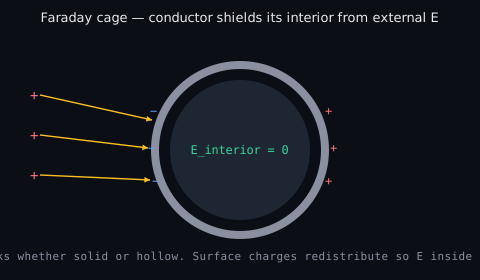
Suppose you have a closed conducting shell (of any shape) with no charge inside the hollow cavity. Then no matter what external charges or fields surround the conductor, the field inside the cavity is zero.
Proof sketch (uniqueness theorem): inside the cavity, \(\nabla^2 V = 0\) (no charge). The cavity wall is at some constant potential \(V_0\). A candidate solution is \(V(\vec r) \equiv V_0\), which satisfies Laplace's equation and the boundary condition. By uniqueness it's the solution. Constant potential means \(\vec E = 0\).
Charge inside the cavity
Now put a charge \(+q\) inside a cavity of a neutral conductor. Two things happen:
- Inner wall: a charge of \(-q\) is induced on the cavity wall (Gauss's law applied to a surface in the bulk, where \(\vec E = 0\), enclosing the cavity).
- Outer surface: by charge conservation, \(+q\) appears on the outer surface. It distributes itself however the external boundary conditions demand — it knows nothing about the location of the inner charge.
So the outside world sees an effective charge \(+q\) on the outer surface, while the cavity world sees only the original \(+q\) plus its induced \(-q\) on the wall. The inside and outside are electrostatically decoupled by the conductor.
A clean statement
The field inside a cavity depends only on the charges inside the cavity. The field outside the conductor depends only on the charges outside plus the total charge on the outer surface.
Earnshaw revisited
You can't use conductors to trap a charge stably either. In a charge-free region, \(\nabla^2 V = 0\); solutions have no interior minima. Any "trap" configuration using conductors alone fails — the charge will always find a saddle direction to escape. (This is why magnetic or time-dependent fields are needed for ion traps.)
Practical consequences
- Electronics shielding: sensitive circuits live in metal enclosures (cell-phone cases, MRI rooms, anechoic chambers).
- Lightning: car bodies act as approximate Faraday cages.
- Microwave oven: the metal mesh in the door blocks microwaves from escaping (works because wavelength \(\gg\) hole size).
Practice Problems
Hint
Solution
The cavity is empty of charge and enclosed by an equipotential; \(\vec E = 0\) inside by uniqueness. Induced charges sit on the outer surface of the shell; the inner surface is bare.
Answer: \(\vec E = 0\) inside; induced charges live only on the outer surface.
Hint
Solution
(a) Force on \(q_1\): By the cavity-screening argument, the only field that reaches \(q_1\) comes from charges inside its cavity. With \(q_1\) at the center of a spherical cavity, the induced \(-q_1\) on the cavity wall is uniform and exerts zero force on \(q_1\). \(F_1 = 0\). Same for \(q_2\).
(b) Wall 1 has induced \(-q_1\); wall 2 has induced \(-q_2\). By conservation, the outer surface has \(+q_1 + q_2\) total. The presence of \(q_0\) reshuffles that charge on the outer surface but doesn't change the total (conductor is neutral except for these induced redistributions).
(c) Force on the conductor: approximately the Coulomb force between \(q_0\) and the effective outer-surface charge \(q_1 + q_2\), treating the conductor as a point charge at \(d \gg R\): \(F \approx \frac{1}{4\pi\epsilon_0}\frac{q_0(q_1 + q_2)}{d^2}\).
Answer: \(F_1 = F_2 = 0\); walls: \(-q_1\), \(-q_2\); outer surface: \(+q_1 + q_2\); \(F_\text{cond} \approx kq_0(q_1+q_2)/d^2\).
Hint
Solution
Inner wall: non-uniform — denser near \(q\). The induced distribution exactly cancels the field of \(q\) outside the cavity. Outer surface: uniform (by symmetry, since the conductor's outer boundary is a sphere and no external charges are present). The outer surface carries \(+q\) spread uniformly — the conductor hides where \(q\) is inside.
Answer: inner wall non-uniform, outer surface uniform at \(\sigma = q/(4\pi R^2)\).
Hint
Solution
Stability at a point \(P\) would require that \(V\) (for a positive test charge) has a local minimum at \(P\) — meaning \(\nabla^2 V > 0\) there. But in a charge-free region, \(\nabla^2 V = 0\) (Laplace's equation). Contradiction — so no strict minimum exists. At best you get saddles, which aren't stable. Conclusion: no static electrostatic trap for point charges.
Answer: Laplace's equation forbids interior minima of \(V\), so no stable equilibrium.