Method of Images: Plane
Chapter 3 — Conductors
Trying to find the field of a point charge above a grounded plane looks terrifying: we don't know how the induced charge distributes. The method of images uses the uniqueness theorem to replace the conductor with a single fictitious charge — and the problem becomes a two-charge Coulomb problem.
Setup
A point charge \(q\) sits a distance \(d\) above an infinite, grounded (\(V = 0\)) conducting plane. Free electrons in the conductor are drawn toward the patch right below \(q\), producing an induced negative charge distribution on the surface.
The image trick
Replace the conductor with a second point charge \(-q\) mirrored through the plane (at distance \(d\) below). Two observations:
- In the region above the plane, both problems have the same physical source (\(+q\) at the same location).
- On the plane itself, the two-charge configuration has \(V = 0\) by symmetry (every point is equidistant from \(+q\) and \(-q\)).
Above the plane, the candidate potential satisfies Poisson's equation with the right source and matches the boundary condition \(V = 0\) on the plane (and \(V\to 0\) at infinity). By the uniqueness theorem it is the potential. Done.
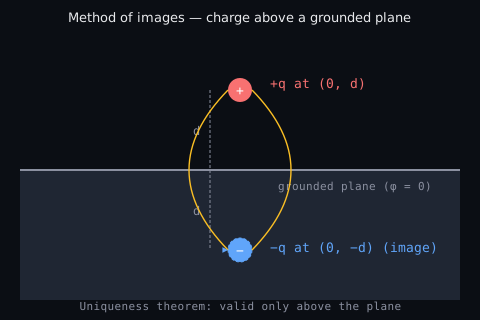
Potential and field (above the plane)
Let the charge be at \((0,0,d)\) and the image at \((0,0,-d)\). For \(z > 0\):
\[V(x,y,z) = \frac{1}{4\pi\epsilon_0}\left[\frac{q}{\sqrt{x^2+y^2+(z-d)^2}} - \frac{q}{\sqrt{x^2+y^2+(z+d)^2}}\right].\]
Below the plane (inside the conductor), \(V = 0\) and \(\vec E = 0\). The image charge is a calculational fiction; it doesn't live in the physical region.
Force on the real charge
The real charge feels the force from the induced charge distribution, which (above the plane) is exactly the force it would feel from the image charge \(-q\) at distance \(2d\):
\[F = \frac{1}{4\pi\epsilon_0}\frac{q(-q)}{(2d)^2} = -\frac{1}{4\pi\epsilon_0}\frac{q^2}{4d^2}.\]
The minus sign means attractive — toward the plane.
Induced surface charge
At a point on the plane a horizontal distance \(s\) from the foot of the charge, the field just above is purely normal. Using superposition of the \(z\)-components of \(\vec E\) from \(+q\) and \(-q\):
\[E_z(s) = -\frac{1}{4\pi\epsilon_0}\frac{2qd}{(s^2+d^2)^{3/2}}.\]
The induced surface density is \(\sigma(s) = -\epsilon_0 E_z = -\frac{qd}{2\pi(s^2+d^2)^{3/2}}\) (with our sign convention, taking \(\hat n\) as \(+\hat z\)). Integrating over the plane gives total induced charge \(-q\), as expected.
Why you can't use the image charge to compute energy naively
The electrostatic energy of the real system is half what you'd compute for the two-charge system:
\[U = -\frac{1}{4\pi\epsilon_0}\frac{q^2}{4d},\]
not \(-\frac{q^2}{4\pi\epsilon_0(2d)}\). The missing factor of 2 comes from the fact that only half of space is physical in the real problem — the energy density lives only above the plane.
Practice Problems
Hint
Solution
\(F = \dfrac{(9\times 10^9)(2\times 10^{-9})^2}{(0.10)^2} = 3.6\times 10^{-6}\,\mathrm{N}\), toward the plane.
Answer: \(\approx 3.6\,\mu\mathrm{N}\) attractive.
Hint
Solution
\(|\sigma(s)| = \frac{qd}{2\pi(s^2+d^2)^{3/2}}\) is maximized at \(s = 0\): \(|\sigma|_{\max} = \frac{q}{2\pi d^2}\).
Answer: \(|\sigma|_{\max} = q/(2\pi d^2)\).
Hint
Solution
\[Q_\text{ind} = \int_0^\infty -\frac{qd}{2\pi(s^2+d^2)^{3/2}}\cdot 2\pi s\,ds = -qd\int_0^\infty \frac{s\,ds}{(s^2+d^2)^{3/2}}.\]
Let \(u = s^2 + d^2\), \(du = 2s\,ds\): \(\int = \tfrac{1}{2}\int_{d^2}^\infty u^{-3/2}\,du = \tfrac{1}{2}\cdot[-2u^{-1/2}]_{d^2}^\infty = 1/d\). So \(Q_\text{ind} = -qd\cdot (1/d) = -q\).
Answer: \(Q_\text{ind} = -q\). ✓
Hint
Solution
Reflect across \(z = 0\): image \(-q\) at \((a, 0, -d)\). Reflect the pair across \(x = 0\): images \(-q\) at \((-a, 0, d)\) and \(+q\) at \((-a, 0, -d)\). Verify: on each plane, the four charges give \(V = 0\) by symmetry.
Answer: three image charges: \(-q\) at \((a,0,-d)\), \(-q\) at \((-a,0,d)\), and \(+q\) at \((-a,0,-d)\).