Curl
Chapter 2 — Vector Calculus
The curl is a second type of vector derivative — divergence's rotational sibling. While divergence measures spreading (flux per unit volume), curl measures twisting (circulation per unit area). The result is a vector field whose direction and magnitude encode how much, and about which axis, the field \(\vec{F}\) locally swirls.
From circulation to curl
The circulation of \(\vec{F}\) around a closed curve \(C\) is
\[\Gamma = \oint_C \vec{F}\cdot d\vec{r}.\]
If \(C\) bounds a tiny flat patch of area \(A\) with unit normal \(\hat{n}\) (oriented by the right-hand rule), the curl at that point, projected onto \(\hat{n}\), is
\[(\vec{\nabla}\times\vec{F})\cdot\hat{n} = \lim_{A\to 0}\frac{1}{A}\oint_C \vec{F}\cdot d\vec{r}.\]
Doing this for loops perpendicular to each coordinate axis picks off the three components of \(\vec{\nabla}\times\vec{F}\).
Cartesian formula
The usual "determinant" mnemonic:
\[\vec{\nabla}\times\vec{F} = \begin{vmatrix}\hat{x} & \hat{y} & \hat{z} \\ \partial_x & \partial_y & \partial_z \\ F_x & F_y & F_z\end{vmatrix}\]
which expands to
\[\vec{\nabla}\times\vec{F} = \left(\partial_y F_z - \partial_z F_y,\ \partial_z F_x - \partial_x F_z,\ \partial_x F_y - \partial_y F_x\right).\]
Each component is "cyclic": the \(z\)-component involves \(\partial_x F_y - \partial_y F_x\), and the others follow by cyclic permutation \(x\to y\to z\to x\).
Physical picture
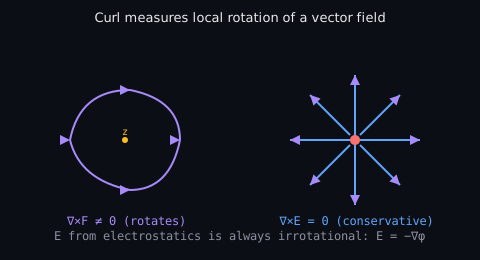
Imagine dropping a tiny paddle wheel into the field \(\vec{F}\) (thinking of it as fluid velocity). Where \(\vec{\nabla}\times\vec{F}\neq 0\), the wheel spins. The axis of spin is parallel to \(\vec{\nabla}\times\vec{F}\); the rate of spin is proportional to its magnitude. A "shearing" field like \(\vec{F}=(y,0,0)\) has a nonzero curl even though none of the arrows appear to rotate individually.
A crucial identity
For any smooth scalar field \(\phi\),
\[\vec{\nabla}\times(\vec{\nabla}\phi) = 0.\]
The curl of any gradient is zero. This is a consequence of the equality of mixed partials: each component of \(\vec{\nabla}\times\vec{\nabla}\phi\) is of the form \(\partial_x\partial_y\phi - \partial_y\partial_x\phi = 0\). Since \(\vec{E}=-\vec{\nabla} V\), it follows immediately that electrostatic fields have zero curl everywhere.
Worked examples
(1) Let \(\vec{F}=(cy,cx,0)\). Then \(\partial_x F_y - \partial_y F_x = c - c = 0\), and the other components involve \(\partial_z\) of zeros. So \(\vec{\nabla}\times\vec{F} = 0\). This field is a valid electrostatic field, and indeed comes from the potential \(V = -cxy\).
(2) Now try \(\vec{F}=(cy,-cx,0)\). Same recipe: \(\partial_x(-cx) - \partial_y(cy) = -c - c = -2c \neq 0\). So \(\vec{\nabla}\times\vec{F} = -2c\,\hat{z}\). This one is not electrostatic — no potential exists for it.
Practice Problems
Hint
Solution
\(\partial_x(x) - \partial_y(0) = 1\). Other components are zero.
Answer: \(\vec{\nabla}\times\vec{F} = \hat{z}\).
Hint
Solution
\(z\)-component: \(\partial_x(-x) - \partial_y(y) = -1-1 = -2\). Others zero.
Answer: \(\vec{\nabla}\times\vec{F} = -2\hat{z}\).
Hint
Solution
\(\vec{F} = \vec{\nabla}(\tfrac12(x^2+y^2+z^2))\), so it's a gradient. Any gradient has zero curl. Direct: each component involves \(\partial_i x_j\) with \(i\neq j\), all zero.
Answer: yes, \(\vec{\nabla}\times\vec{F} = 0\).
Hint
Solution
\(x\)-comp: \(\partial_y(xy) - \partial_z(zx) = x - x = 0\). \(y\)-comp: \(\partial_z(yz) - \partial_x(xy) = y - y = 0\). \(z\)-comp: \(\partial_x(zx) - \partial_y(yz) = z - z = 0\).
Answer: \(\vec{\nabla}\times\vec{F} = \vec{0}\). (It's a gradient: \(\vec{F} = \vec{\nabla}(xyz)\).)
Hint
Solution
Direct computation gives \(\vec{\nabla}\times\vec{F} = 0\) everywhere \(\vec{F}\) is defined — so locally it looks fine. But it has nonzero circulation \(2\pi\) around any loop enclosing the origin, so no single-valued potential exists globally. In physics terms, it's not a valid electrostatic field because the origin isn't part of the simply-connected domain.
Answer: curl is zero on its domain, but circulation around the \(z\)-axis is nonzero — no global potential exists, so not a valid electrostatic field in vacuum.
Hint
Solution
The \(z\)-component of \(\vec{\nabla}\times(\vec{\nabla}\phi)\) is \(\partial_x(\partial_y\phi) - \partial_y(\partial_x\phi) = \partial_x\partial_y\phi - \partial_y\partial_x\phi = 0\) by Clairaut's theorem. The same argument (with cyclic swaps) kills the other components.
Answer: equality of mixed partials makes every component vanish.