Coulomb's Law & Superposition
Chapter 1 — Electrostatics
Electric charge comes in two signs, is conserved, and is quantized in units of \(e = 1.6\times 10^{-19}\) C. The whole of electrostatics is built from one empirical statement: the force between two point charges. Everything else — fields, potentials, Gauss's law — follows from Coulomb's law plus the superposition principle.
The formula
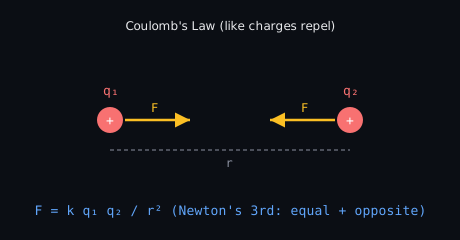
For a point charge \(q_1\) at position \(\vec{r}_1\) and \(q_2\) at \(\vec{r}_2\), the force on \(q_2\) due to \(q_1\) is
\[\vec{F}_{2} = \frac{1}{4\pi\epsilon_0}\frac{q_1 q_2}{r_{21}^2}\,\hat{r}_{21},\]
where \(\vec{r}_{21} = \vec{r}_2 - \vec{r}_1\) points from the source to the target and \(\hat{r}_{21}\) is its unit vector. With the sign convention built in, like charges repel (force along \(\hat{r}_{21}\)) and opposite charges attract.
The constant is \(k = 1/(4\pi\epsilon_0) \approx 8.99\times 10^9\) N·m\(^2\)/C\(^2\), with \(\epsilon_0 = 8.854\times 10^{-12}\) C\(^2\)/(N·m\(^2\)).
Key properties
Three features jump out and shape everything downstream:
- Linear in each charge. Doubling either charge doubles the force. This is what makes superposition work.
- Inverse square. \(|\vec F|\propto 1/r^2\). We'll later see via Gauss's law that this is forced by the fact that we live in 3D.
- Central. The force points along the line between the charges. Symmetry demands this for point charges in empty space.
Coulomb's law also obeys Newton's 3rd law: swap the labels and you get \(\vec F_1 = -\vec F_2\).
Superposition
The force on a target charge due to a collection of sources is the vector sum of the pairwise Coulomb forces:
\[\vec F_{\text{on }q} = \sum_i \frac{1}{4\pi\epsilon_0}\frac{q\, q_i}{|\vec r - \vec r_i|^2}\,\hat{r}_i,\quad \hat r_i = \frac{\vec r - \vec r_i}{|\vec r - \vec r_i|}.\]
The presence of a third charge doesn't alter the force between the first two. Superposition relies on Coulomb's law being linear in the charges — if it went like \(q_1^2 q_2^2\) the principle would fail instantly.
Practice Problems
Hint
Solution
\(F = (9\times 10^9)(1.6\times 10^{-19})^2/(10^{-10})^2 = 9\times 10^9 \cdot 2.56\times 10^{-38}/10^{-20} \approx 2.3\times 10^{-8}\) N.
Answer: \(\approx 2.3\times 10^{-8}\) N, repulsive.
Hint
Solution
By symmetry the forces cancel: each outer charge pushes the middle charge away with the same magnitude \(kq^2/(a/2)^2\), but in opposite directions.
Answer: \(\vec F = 0\) (unstable equilibrium).
Hint
Solution
Each source exerts \(F_0 = kq^2/a^2\) on the target. The angle between them (as seen from the target) is \(60°\), so they each contribute a component \(F_0 \cos 30° = F_0 \sqrt{3}/2\) along the symmetry axis, and the perpendicular components cancel. Net \(F = 2 F_0 \cos 30° = \sqrt{3}\, kq^2/a^2\).
Answer: \(\sqrt{3}\,kq^2/a^2\), directed away from the centroid.
Hint
Solution
At \(x > d\), the \(+Q\) pushes \(+q'\) further right (repel), the \(-q\) pulls it left (attract). Set \(kQq'/x^2 = kqq'/(x-d)^2\), so \((x-d)/x = \sqrt{q/Q}\), giving \(x = d/(1 - \sqrt{q/Q})\), provided \(Q > q\).
Answer: \(x = d/(1-\sqrt{q/Q})\), requires \(Q>q\).