Fields of Continuous Distributions
Chapter 1 — Electrostatics
Real objects aren't made of a handful of point charges — they're continuous blobs of charge. Conceptually nothing changes: we slice the object into infinitesimal pieces, each of which acts like a point charge, and add up the contributions as an integral.
Charge densities
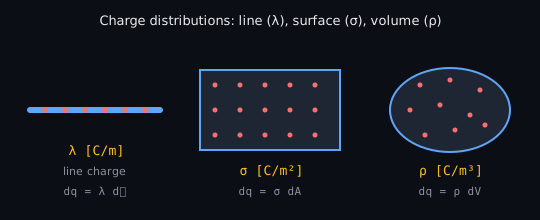
Depending on the geometry you pick one of three densities:
- Volume density \(\rho\) (C/m\(^3\)): \(dq = \rho\, dV\).
- Surface density \(\sigma\) (C/m\(^2\)): \(dq = \sigma\, dA\).
- Line density \(\lambda\) (C/m): \(dq = \lambda\, d\ell\).
The integral
Let \(\vec r\) be the field point and \(\vec r\,'\) run over the source. Define \(\vec s = \vec r - \vec r\,'\). Then the field is
\[\vec E(\vec r) = \frac{1}{4\pi\epsilon_0}\int \frac{dq'}{s^2}\,\hat s = \frac{1}{4\pi\epsilon_0}\int \frac{\rho(\vec r\,')}{s^3}\,\vec s\, dV'.\]
Two different coordinates: \(\vec r\,'\) labels the source (what you integrate over), \(\vec r\) is where you're asking for the field (fixed during the integral).
Strategy: exploit symmetry
Direct integration of the full 3D integral is usually painful. In this course you'll always have enough symmetry to reduce the work:
- Pick coordinates aligned with the symmetry (cylindrical for rings/rods, spherical for shells/balls).
- Identify which components of \(\vec E\) must vanish by symmetry — only integrate the surviving component.
- Write \(dq\) in the natural coordinates and plug in.
For highly symmetric distributions (sphere, infinite line, infinite plane), Gauss's law is dramatically easier than brute-force integration.
Worked example: ring of charge
A thin ring of radius \(R\) carries uniform linear density \(\lambda\). On the axis at height \(z\) above the ring's center, each element contributes a field at distance \(s = \sqrt{R^2 + z^2}\). By symmetry only the \(z\)-component survives. With \(dq = \lambda\, R\, d\phi\),
\[E_z = \frac{1}{4\pi\epsilon_0}\int_0^{2\pi}\frac{\lambda R\,d\phi}{R^2 + z^2}\cdot \frac{z}{\sqrt{R^2+z^2}} = \frac{1}{4\pi\epsilon_0}\frac{Q z}{(R^2+z^2)^{3/2}},\]
where \(Q = 2\pi R\lambda\) is the total charge. As \(z\to\infty\) this reduces to \(kQ/z^2\), as it must.
Practice Problems
Hint
Solution
Every element at angle \(\phi\) is matched by one at \(\phi + \pi\) on the opposite side — their fields cancel at the center.
Answer: \(\vec E = 0\).
Hint
Solution
\(dE_z/dz \propto (R^2+z^2) - 3z^2 = 0\), so \(z^2 = R^2/2\), i.e. \(z = R/\sqrt 2\).
Answer: \(z = R/\sqrt 2\).
Hint
Solution
\(E_x = k\lambda \int_0^L dx'/(x_0-x')^2 = k\lambda \left[\tfrac{1}{x_0-x'}\right]_0^L = k\lambda\left(\tfrac{1}{x_0-L} - \tfrac{1}{x_0}\right) = \tfrac{k\lambda L}{x_0(x_0-L)}\).
Answer: \(E_x = \dfrac{kQ}{x_0(x_0-L)}\) with \(Q = \lambda L\), pointing in \(+\hat x\).
Hint
Solution
\(E_z = \int_0^R \frac{k\,z\,(2\pi\sigma r\, dr)}{(r^2+z^2)^{3/2}} = 2\pi k\sigma z\left[-\tfrac{1}{\sqrt{r^2+z^2}}\right]_0^R = \frac{\sigma}{2\epsilon_0}\left(1 - \frac{z}{\sqrt{R^2+z^2}}\right)\).
Answer: \(E_z = \dfrac{\sigma}{2\epsilon_0}\left(1 - \dfrac{z}{\sqrt{R^2+z^2}}\right)\). As \(R\to\infty\) this tends to \(\sigma/(2\epsilon_0)\) (the infinite-plane result).