Gauss's Law (Integral Form)
Chapter 1 — Electrostatics
Coulomb's law makes a bold prediction: the total electric flux through any closed surface depends only on the charge enclosed, not on where that charge sits inside, nor on the shape of the surface. That statement is Gauss's law — exactly equivalent to Coulomb's law, but dramatically more useful when there's symmetry. The differential form shows up in Chapter 2.
Statement
For any closed surface \(S\) bounding a volume \(V\),
\[\oint_S \vec E\cdot d\vec A = \frac{Q_{\text{enc}}}{\epsilon_0} = 4\pi k\,Q_{\text{enc}},\]
where \(Q_{\text{enc}} = \int_V \rho\, dV\) is the total charge inside \(S\). Charges outside the surface contribute zero net flux.
Why \(1/r^2\)?
Gauss's law plus symmetry forces the point-charge field to go like \(1/r^2\). For a sphere of radius \(r\) around a point charge, \(\Phi = E\cdot 4\pi r^2 = q/\epsilon_0\) gives \(E = kq/r^2\) immediately. In \(n\) spatial dimensions, the sphere surface scales as \(r^{n-1}\), so the Coulomb law would be \(E\propto 1/r^{n-1}\). We live in 3D, so inverse-square it is.
The Gaussian surface recipe
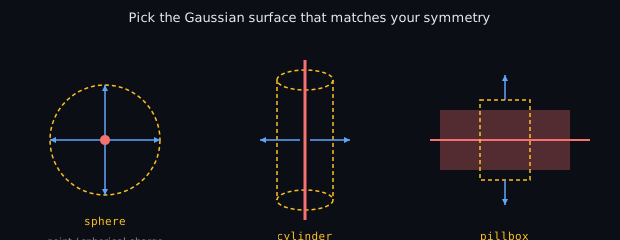
Gauss's law is always true, but it only gives you \(\vec E\) directly when you can find a surface where \(\vec E\cdot d\vec A\) is either zero or constant on each piece. That requires symmetry. The three textbook cases:
- Spherical symmetry → concentric sphere. (shell/ball)
- Cylindrical symmetry (infinite line/wire/cylinder) → coaxial cylinder + flat end caps. (infinite line)
- Planar symmetry (infinite plane/sheet) → pillbox straddling the plane. (infinite plane)
Workflow
Every Gauss's-law problem follows the same script:
- Identify the symmetry. Determine which direction \(\vec E\) must point and what it depends on.
- Choose a Gaussian surface that respects the symmetry — pieces where either \(\vec E\perp d\vec A\) (no contribution) or \(\vec E\parallel d\vec A\) with constant magnitude.
- Compute \(\oint \vec E\cdot d\vec A\) = \(E\) times area of the "active" portion.
- Compute \(Q_{\text{enc}}\) inside your surface.
- Solve for \(E\).
Practice Problems
Hint
Solution
\(\Phi = Q/\epsilon_0 = 5\times 10^{-9}/8.854\times 10^{-12} \approx 565\) V·m.
Answer: \(\approx 565\) N·m\(^2\)/C.
Hint
Solution
\(Q_{\text{enc}} = +2 - 3 = -1\) nC. \(\Phi = -10^{-9}/\epsilon_0 \approx -113\) N·m\(^2\)/C.
Answer: \(\approx -113\) N·m\(^2\)/C.
Hint
Solution
By spherical symmetry \(\vec E = E(r)\hat r\). Flux through a sphere of radius \(r\): \(E\cdot 4\pi r^2 = q/\epsilon_0\). Solve: \(E = q/(4\pi\epsilon_0 r^2) = kq/r^2\).
Answer: \(\vec E = (kq/r^2)\hat r\).
Hint
Solution
\(E\cdot 4\pi r^2 = \rho\cdot \tfrac43\pi r^3/\epsilon_0\), so \(E = \rho r/(3\epsilon_0)\), radially.
Answer: \(\vec E = \dfrac{\rho r}{3\epsilon_0}\hat r\), linear in \(r\) inside.