Parallel-Plate Capacitor
Chapter 3 — Conductors
The parallel-plate capacitor is the workhorse example: two large flat conducting plates separated by a small gap. It's ubiquitous in real circuits and it's the cleanest illustration of how geometry determines capacitance.
Geometry and field
Two plates of area \(A\) separated by a distance \(d\). Charge \(+Q\) on the top plate (surface density \(\sigma = Q/A\)) and \(-Q\) on the bottom. Assuming the plates are "large" (\(d \ll \sqrt A\)), edge effects are negligible and the field between the plates is uniform.
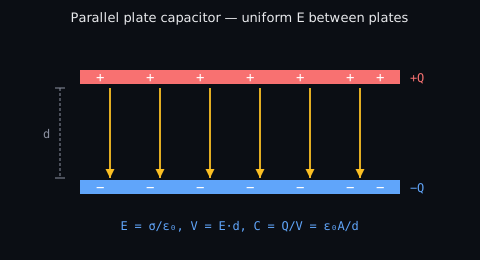
Field between the plates
Two ways to see it. Via surface-charge formula: just outside a conductor \(E = \sigma/\epsilon_0\), and this field points from the \(+\) plate toward the \(-\) plate. Via superposition: each plate, viewed as an isolated sheet, produces \(\sigma/(2\epsilon_0)\). Between the plates these add; outside they cancel. Either way,
\[E = \frac{\sigma}{\epsilon_0} = \frac{Q}{\epsilon_0 A},\quad (\text{between the plates, zero outside}).\]
Potential difference
The field is uniform, so
\[\Delta V = E\,d = \frac{Qd}{\epsilon_0 A}.\]
Capacitance
\[\boxed{\ C = \frac{Q}{\Delta V} = \frac{\epsilon_0 A}{d}.\ }\]
Big plates + small gap = big capacitance. Note the \(Q\) has canceled — capacitance depends only on geometry, as promised.
Plausibility checks
- Increasing \(A\) at fixed \(d\) gives proportional growth — you're just pasting capacitors in parallel.
- Decreasing \(d\) toward 0 sends \(C\to\infty\) — a single conductor can hold any charge at a given \(V\) difference.
- Units: \([\epsilon_0][A]/[d] = \mathrm{F/m}\cdot\mathrm{m} = \mathrm{F}\). ✓
Adding a dielectric (teaser)
If you insert a material with dielectric constant \(\kappa\) (like plastic, \(\kappa\sim 3\)) between the plates, you get \(C = \kappa\epsilon_0 A/d\). This is how real capacitors pack lots of farads into small volumes. (Dielectrics come in a later unit.)
Force between the plates
Each plate feels an attractive force from the other. Using the surface-pressure formula \(F/A = \sigma^2/(2\epsilon_0)\):
\[F = \frac{\sigma^2 A}{2\epsilon_0} = \frac{Q^2}{2\epsilon_0 A}.\]
This is not \(QE\) with \(E = \sigma/\epsilon_0\); that would double-count. The plate feels the field from the other plate, \(\sigma/(2\epsilon_0)\), giving force \(Q\cdot\sigma/(2\epsilon_0)\) — the factor-of-2 story again.
Practice Problems
Hint
Solution
\(A = 10^{-2}\,\mathrm{m^2}\), \(d = 10^{-3}\,\mathrm{m}\). \(C = (8.85\times 10^{-12})(10^{-2})/(10^{-3}) = 8.85\times 10^{-11}\,\mathrm{F} = 88.5\,\mathrm{pF}\).
Answer: \(\approx 89\,\mathrm{pF}\).
Hint
Solution
\(Q\) fixed. \(C = \epsilon_0 A/d\) halves. Field \(E = \sigma/\epsilon_0 = Q/(\epsilon_0 A)\) depends only on \(\sigma\), which is unchanged — so \(E\) stays the same. \(\Delta V = Ed\) doubles.
Answer: \(C\to C/2\), \(E\) unchanged, \(\Delta V\to 2\Delta V\).
Hint
Solution
\(C\) halves. \(Q = C\Delta V\) also halves. \(E = \Delta V/d\) halves.
Answer: \(Q\to Q/2\), \(E\to E/2\).
Hint
Solution
Pressure on each plate: \(P = \sigma^2/(2\epsilon_0) = Q^2/(2\epsilon_0 A^2)\). Total attractive force between plates: \(F = PA = Q^2/(2\epsilon_0 A)\). Equivalently, \(F = \tfrac{1}{2}\epsilon_0 E^2\cdot A\).
Answer: \(F = Q^2/(2\epsilon_0 A)\), attractive.